Research
Modeling and model reduction
Network equivalents, Kron reduction, and singular perturbation methods that shrink power system models while preserving the dynamics a given study depends on.
Optimization and control
Optimal power flow, volt/var control, grid topology reconfiguration, and small-signal stability analysis for systems with high penetration of inverter-based resources.
Learning with guarantees
Deep learning surrogates for optimal power flow, transfer learning for voltage stability margins, and data-driven controllers that come with stability and performance certificates.
Use-inspired power flow modeling for optimization and dynamics
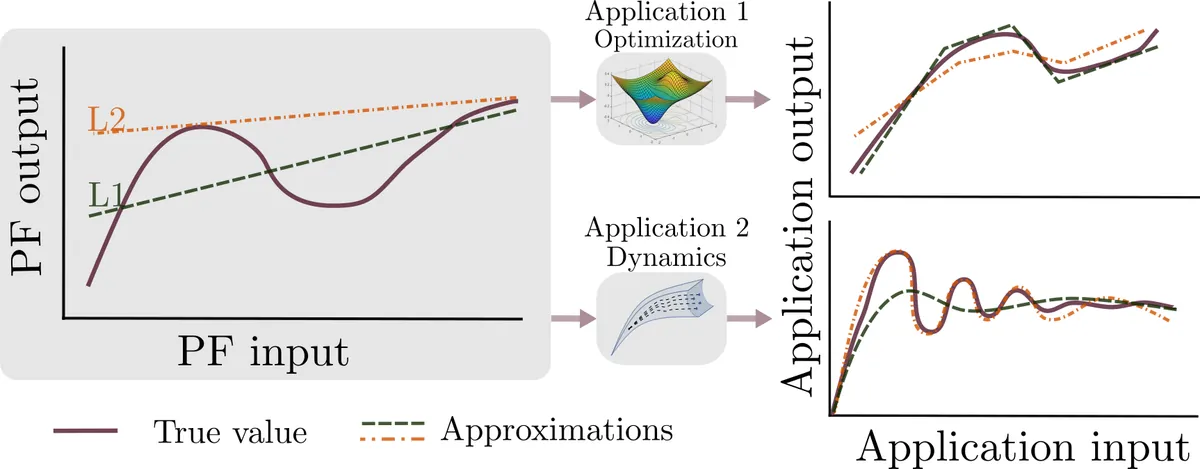
Operating a power grid means solving hard computational problems on a short clock, and the standard way to make that tractable is to replace the AC power flow equations with a linear approximation. Those approximations are almost always designed and judged by how closely they reproduce the power flow equations themselves, with no reference to what the model will actually be used for. This project argues that the accuracy that matters is the accuracy of the application output, and it closes the design loop around the end use.
We develop certifiably optimal power flow linearizations tailored to three settings, deterministic optimization, stochastic optimization, and dynamic modeling, covering canonical problems such as bulk system dispatch, distributed energy resource management, voltage control, uncertainty management, planning, and time-domain simulation. The technical approach draws on bilevel and stochastic optimization, systems theory, sensitivity analysis, automatic differentiation, system identification, and neural networks, so that input data distributions and application structure enter the linearization process explicitly rather than by convention.

Supported by the U.S. National Science Foundation. Award ECCS-2453151, Division of Electrical, Communications and Cyber Systems, Energy, Power and Control Systems program. June 2025 to May 2028. Manish K. Singh, sole PI.
Selected publications
V. Kekatos, R. Annin, M. K. Singh, and J. Qin, “Solving optimal power flow on a data budget: Feature selection on smart meter data,” IEEE Transactions on Power Systems, vol. 41, no. 3, pp. 1978–1991, 2026.
Y. Chen and M. K. Singh, “Optimally linearizing power flow equations for improved power system dispatch,” in Proc. IEEE Conference on Decision and Control, Rio de Janeiro, Brazil, 2025.
E. Haag, Y. Chen, G. Venkataramanan, and M. K. Singh, “Assessing power flow controllability via variable line reactance,” in Proc. IEEE PES General Meeting, Montreal, Canada, 2026.
Improving grid strength and flexibility using grid-enhancing technologies
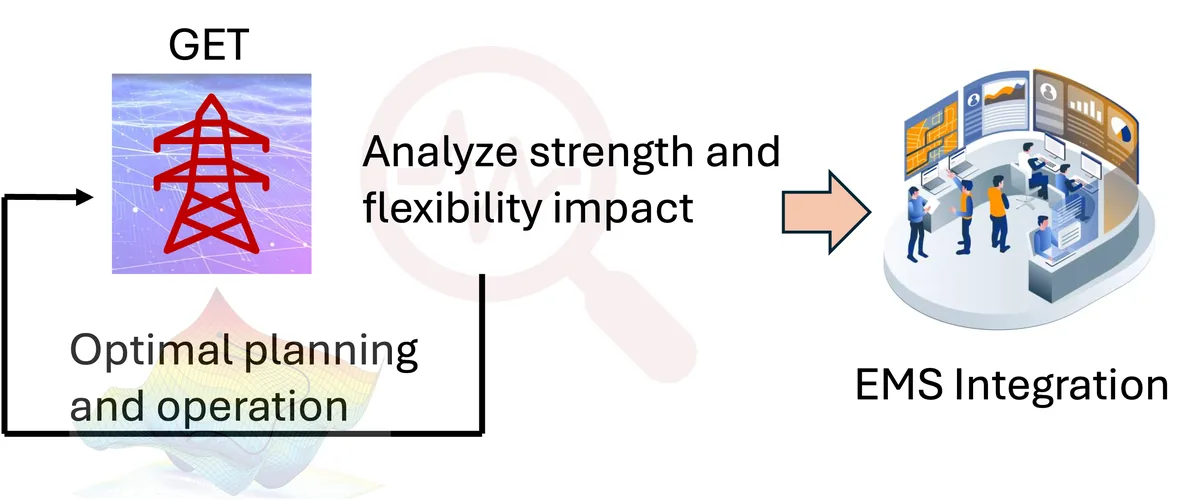
This project improves the strength and flexibility of the electric grid by making better use of grid-enhancing technologies, or GETs: advanced conductors, power flow controllers, phase-shifting transformers, and dynamic line rating. GETs are known for raising transmission capacity, but their broader system-level effects are far less understood, particularly their contribution to grid strength in systems rich in inverter-based resources.
We are developing new metrics, scalable algorithms, and integration strategies that characterize and optimize GETs for modern IBR-rich grids. The goal is to widen the understanding of what GETs can do at the system level, and to make them usable inside the planning and operation tools that utilities already run, including energy management systems, so the grid becomes more resilient and more adaptable.

Supported by the Power Systems Engineering Research Center. Project S-117, August 2026 to July 2028. Manish K. Singh, project leader, with Bai Cui and Venkataramana Ajjarapu (Iowa State University), and industry members from ISO-NE, CAISO, NYISO, PJM, MISO, RTE-France, SRP, Dominion Energy, NYPA, Eaton, EPRI, and NREL.
Selected publications
E. Haag, Y. Chen, G. Venkataramanan, and M. K. Singh, “Assessing power flow controllability via variable line reactance,” in Proc. IEEE PES General Meeting, Montreal, Canada, 2026.
More topics that have recently excited us
Recent work from the group that sits outside the funded projects above, from the last three years.
P. Zhang, L. Roald, and M. K. Singh, “Optimal measurement selection for certifiable voltage monitoring in power distribution systems,” Hawaii International Conference on System Sciences, 2027. · arXiv · Code
Y. Huang, D. B. Sapkota, and M. K. Singh, “Optimal singular perturbation-based model reduction for heterogeneous power systems,” in Proc. IEEE PES General Meeting, Montreal, Canada, 2026. · arXiv
V. Kekatos, R. Annin, M. K. Singh, and J. Qin, “Scheduling distributed energy resources under limited observability of distribution grids,” Sustainable Energy, Grids and Networks, vol. 43, art. 101866, 2025. Presented at the Bulk Power Systems Dynamics and Control Symposium (IREP), Sorrento, Italy. · Paper
B. C. Lesieutre and M. K. Singh, “Model expansion to realize preferred topologies,” in Proc. Allerton Conference on Communication, Control, and Computing, Allerton, IL, 2025. Invited paper. · Paper
A. Gupta, M. K. Singh, and V. Kekatos, “Incorporating power system stability metrics into the optimal power flow,” in Proc. American Control Conference, Denver, CO, pp. 723–728, 2025. · Paper
Book chapter. V. Kekatos and M. K. Singh, “Deep learning techniques for solving optimal power flow problems,” in Smart Cyber-Physical Power Systems: Solutions from Emerging Technologies, Volume 2, A. Parizad, H. R. Baghaee, and S. Rahman, Eds. John Wiley & Sons, 2025, ch. 17, pp. 471–500. · Paper
K. D. Polyzos, P. A. Traganitis, M. K. Singh, and G. B. Giannakis, “Ensembles of informative representations for self-supervised learning,” in Proc. IEEE International Workshop on Machine Learning for Signal Processing, London, UK, 2024. Best paper award, second place. · Paper
H. T. Jung, S. Helman, M. K. Singh, and S. Dhople, “Inferences from numerical model reduction and aggregation of power-system dynamics featuring primary and secondary control,” in Proc. IEEE PES General Meeting, Seattle, WA, 2024. · Paper